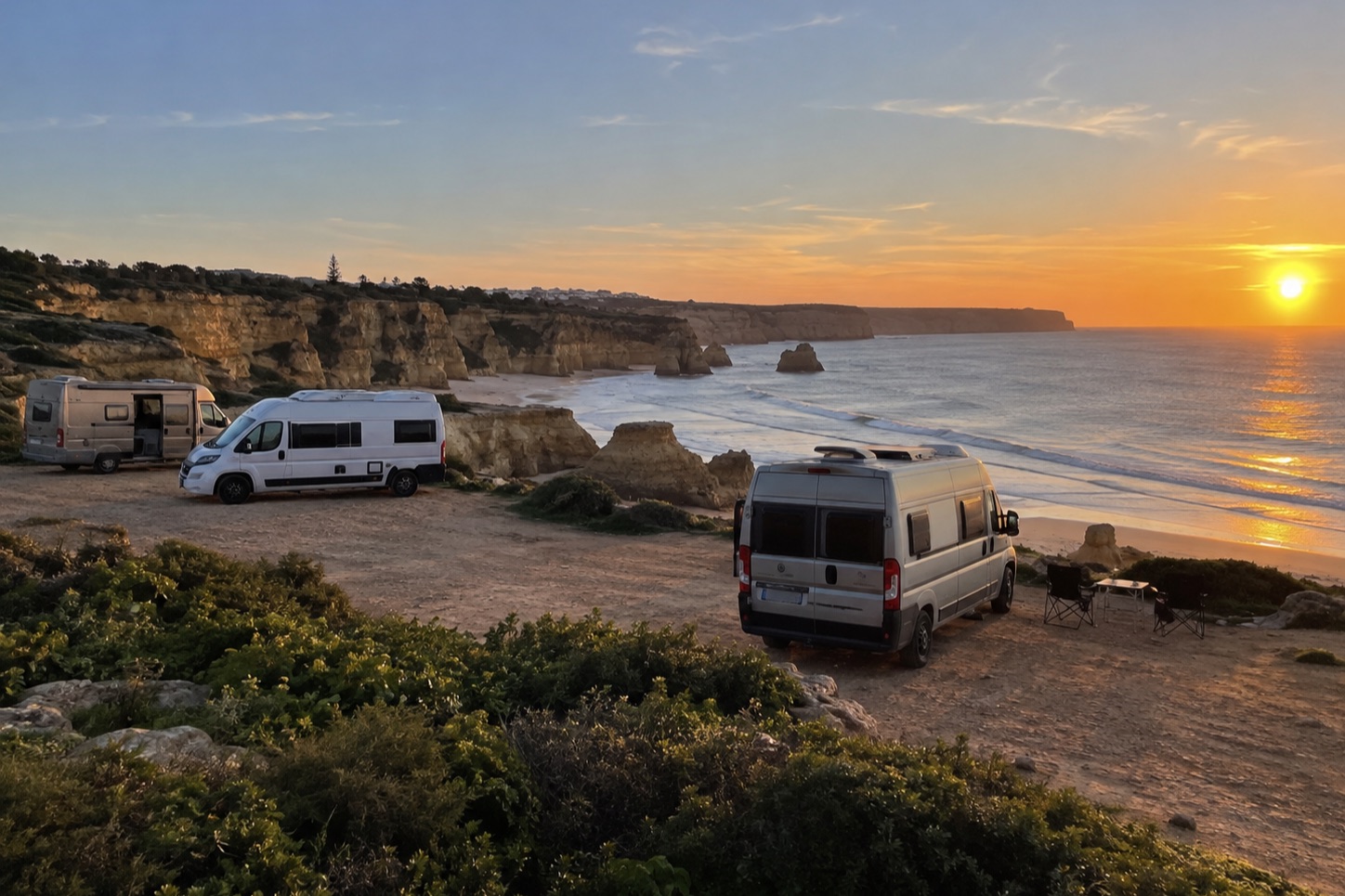
Why everyone drives south
Vanlife in Norway in January is possible, and we have written about how to do it. Most people do not. Around the second week of October the trailhead car parks up north empty out, and by the end of November the same vans are parked above surf beaches in the south-west corner of Portugal. It is one of the most predictable migrations in Europe, and once you have done it you understand why. Faro averages 16 degrees in December and January and 17 in February. There are eight to ten days with rain in each of those months, most of it in December, and five to six hours of sunshine a day between the showers. Compare that to Oslo, where the sun sets before four and the ground is frozen until March.
The other reason is people. The Algarve in winter has the highest density of vanlifers anywhere in Europe outside a festival. You are not going to be alone at the end of a forest track. You are going to be one of forty vans at a service area outside Lagos, and the person parked next to you will have driven down from Hamburg, Utrecht, or Gothenburg the same week you did. If the northern summer was about landscape, the southern winter is about company. Plan for that and it becomes the best part.
The weather, honestly
Sixteen degrees in the day sounds gentle, and it is, in the sun. Nights drop to eight or nine, the air is damp, and the wind on the west coast can blow for days. The Atlantic side around Sagres and Aljezur gets the weather first and gets it hardest. The south coast from Lagos east to Tavira is sheltered, warmer, and a few degrees calmer. If you are chasing surf you will live on the west side and complain about the wind. If you are chasing warmth you will drift east and complain about the crowds.
You do not need the Norway kit. A small diesel heater for the evenings and a way to manage condensation are enough. What catches people out is December rain. Three wet days in a row in a van with no heating and no dehumidification is miserable anywhere, and it happens here. A heater you can run for an hour in the morning to dry the van out matters more than one that can hold minus fifteen.
What is legal now
Until 2020, Portugal was the free-camping capital of Europe. Then the car parks above the best beaches filled with vans that stayed for weeks, locals could not park, and the government changed the highway code. The rules were tightened in early 2021 and relaxed a little that summer, and this is where they have stayed since.
- 48 hours, in a registered motorhome. You may sleep in your vehicle for up to 48 hours in the same municipality, as long as it is registered as a motorhome with the IMT. A self-build still registered as a goods van does not qualify on paper.
- No camping behaviour. Sleeping inside is parking. Chairs, a table, an awning, or a stove on the ground is camping, and camping outside a campsite is not allowed. Keep it inside and you are fine.
- Not on the protected coast. Natura 2000 areas, protected landscapes, and the coastal zones covered by the coastal development plans are off limits for overnighting, full stop. That includes most of the Costa Vicentina and the Ria Formosa. The dirt track to the clifftop with the perfect view is almost always inside one of these.
- Fines. 60 to 300 euros, doubled to 120 to 600 in protected areas. The GNR do patrol the famous spots in winter, usually at dawn.
What replaced the beach car parks is a network of municipal motorhome service areas, called ASAs, where you get water, waste disposal, and often electricity for a few euros a night, plus campsites that stay open all year. With a CampingCard ACSI most Algarve campsites charge a fixed 13 to 27 euros a night in low season, and nearly all of them do weekly and monthly rates that bring it well under that. Plenty of people spend January on a campsite for the price of a week in a Norwegian cabin.
The practical upshot: the community did not leave Portugal when the law changed. It concentrated. A service area with thirty vans in it is a very easy place to meet people.
Where the vans actually are, west to east
The Algarve is small. You can drive from the western tip to the Spanish border in two hours. But the scene sorts itself along that road in a way that is worth knowing before you pick a base.
- The west coast: Aljezur, Arrifana, Carrapateira, Sagres. Surf, wind, and the youngest crowd. Self-builds, Sprinters with boards on the roof, a lot of German and Dutch plates and more Scandinavians every year. Almost all of this coast is protected, so people sleep at the service areas and campsites in the villages and drive to the beaches in the morning. Sagres is the anchor. If you want to find the surfers, start there.
- Barão de São João. A small village in the hills behind Lagos that has been a vanlife hangout since the eighties. The famous monthly hippie market is gone, but the cafés and the crowd are still there, and the generation that arrived in the nineties settled on plots in the surrounding hills. Worth a Sunday.
- Lagos to Portimão. Lagos is the winter capital for the 25 to 40 crowd. Big enough to have everything, small enough to bump into the same faces. Praia da Luz and Salema to the west are the quieter satellites, and the campsites and service areas here fill up first.
- The middle: Albufeira, Armação de Pêra, Quarteira. More motorhomes than vans, an older crowd, and people who arrive in November and do not move until March. Big campsites, long-stay pitches, bridge on Tuesdays. Not the scene most vanlifers are looking for, but the warmest and most sheltered part of the coast.
- The east: Olhão, Tavira, Vila Real de Santo António. Quieter, flatter, and beautiful in a different way. The Ria Formosa lagoon is protected so again it is campsites and service areas, but there are good ones. Tavira has a steady winter community of long-stayers and a lot of British and Dutch vans. It is also thirty minutes from Spain, which matters when your 48 hours are up.
- On the way down: the Alentejo coast. Porto Covo, Vila Nova de Milfontes, Zambujeira do Mar. Rainier than the Algarve in winter and emptier, which is exactly why some people stop here and never make it further south.
Beyond Portugal, the same crowd rotates into Spain. The Costa de la Luz between Cádiz and Tarifa has the kite and surf people, the aires around Conil cost about fifteen euros with water and showers, and Cabo de Gata outside Almería is the driest corner of Europe when the Algarve is under a week of rain. Many people do Portugal until Christmas and Spain until March, or the other way round.
How to tell you have found the cluster
The signs are the same as in the Nordics, just with more vans. Boards drying on a roof rack. A dog tied to a bumper. Someone working on a laptop in an open sliding door at eleven in the morning. Two vans parked with their doors facing each other and camping chairs suspiciously close to the threshold, because the rule is chairs inside and everybody is just about honouring it. The service area with a queue for the water tap at ten in the morning is the social one. The empty one with the perfect view is empty for a reason, and the reason is usually a sign you did not read.
See who is already there before you arrive
This is the season Vanderlust was made for. The live map shows how many travellers are in each area right now, so if you zoom out over Europe in the first week of January you can watch the whole migration: a thin scatter across Germany and France, then a dense band along the south coast of Portugal and Spain. Zoom in and you can see whether Sagres or Tavira has more people this week, before you commit to a drive.
Discover shows you people nearby, and the distance filter has a setting for regional as well as local, which matters here because the whole Algarve is regional. Set it wide while you are still in Alentejo and you will be waving at people in Lagos three days before you get there.
The feature most people miss is the route planner. Add Sagres or Tavira as a stop on your route and your profile starts showing "Heading to Sagres" to people who are already there, and their cards show "At your destination" to you. Connecting before you arrive is the difference between pulling into a service area full of strangers and pulling in to find someone who saved you a spot.
And use the status line. "In Sagres until Sunday, up for a surf or a coffee" gets more replies in a week than a bio ever will, because it tells someone exactly what to say. Our profile guide goes through the rest, and if the first message is the hard part, the icebreakers guide has twenty that work.
Vanderlust is free. Open the map, zoom out to Europe, and see where the vans are this week. Add your next stop and the people already there can find you before you arrive.


The drive down from the Nordics
Oslo to the Algarve is roughly 3,400 kilometres by road. Driven hard it is five or six days. Driven the way most people do it, with a stop at everything that looks interesting on the way, it is two or three weeks, and it is a better trip.
- Getting off the peninsula. Ferry from Oslo or Gothenburg to Kiel, or from Trelleborg to Rostock, saves a day of Danish motorway and a night's sleep. Driving down through Denmark over the bridges is cheaper if you are already in the south of Sweden.
- Germany to the Spanish border. Straight down the west of Germany, into France, and along the Atlantic coast via Bordeaux to the border at Irun. The French motorways are fast and expensive. The N-roads are slow, free, and full of small towns with a free municipal aire. Most people do a mix.
- Through Spain. Two choices. Along the north coast and then south through Salamanca to cross into Portugal at Elvas, or down the middle via Burgos and Madrid and then west. Either way you are crossing the meseta, and the meseta in November is cold. Expect frost at night around Burgos and Salamanca. This is where your heater earns its keep on the way down, not in Portugal.
- Winter tyres. Required in Norway and Sweden when you leave, useless in Portugal. Most people drive down on them and live with the wear. If you leave after the first of November check the rules for the German stretch, which require winter-capable tyres in winter conditions.
The thing nobody mentions about the drive is that you are not doing it alone. The whole of northern Europe is on the same roads in October and November, and the aires around Bordeaux and the service areas on the Spanish north coast are full of vans doing exactly what you are doing. Some of the friendships that last the whole winter start at a supermarket car park in Aquitaine.
Small practical things
- Gas. Portuguese exchange bottles use their own fittings and a Nordic bottle will not be refilled. A refillable LPG system with a European adapter set is the least painful option. Autogas is available at a reasonable number of stations, more in Spain than in Portugal.
- Water and waste. The service areas. This is what they are for, and it is the reason the whole system works. Use them even when you are sleeping elsewhere.
- Signal. Excellent along the whole coast, and a local eSIM is cheaper than roaming for a three-month stay. The west coast valleys are the only place it drops.
- Money. Fuel is cheaper than home, food is much cheaper, and a beer at a café is two euros. The winter that costs a fortune in Norway is affordable here.
- Language. English is fine on the coast. A few words of Portuguese get you a very different reception in the villages.
Be the van they want to keep
The 2021 law exists because of vans that stayed for a month in a beach car park with chairs out and a toilet emptied in the dunes. The locals who lost their parking remember it, and the reception you get depends on whether you look like that or not. The rules are not complicated. Move after two nights. Keep the chairs inside. Never sleep on the protected coast, however good the spot looks. Empty at the service area. Buy your bread in the village. Do that and Portugal is still the easiest, warmest, and most social winter in Europe.
FAQ
Is wild camping legal in Portugal in winter?
Not in the way it was before 2021. You can sleep inside a registered motorhome for up to 48 hours in the same municipality as long as nothing is set up outside the vehicle, and never in protected areas or on the protected coast. Everything else is motorhome service areas and campsites, and there are plenty of both.
How warm is the Algarve in January?
Around 16 degrees in the day and 8 to 9 at night, with eight to ten rainy days in the month and five to six hours of sun. The south coast east of Lagos is warmer and more sheltered than the west coast around Sagres.
Where do vanlifers meet in the Algarve?
Sagres and the west coast villages for the surf crowd, Lagos for the 25 to 40 crowd, Tavira in the east for long-stayers. Since 2021 most of the scene is at motorhome service areas and year-round campsites rather than beach car parks. The Vanderlust map shows how many travellers are in each area right now.
How long does it take to drive from Norway to Portugal in a van?
Oslo to the Algarve is roughly 3,400 kilometres. Five to six days if you push, two to three weeks if you enjoy it. Expect frost at night crossing central Spain in November.
Is Portugal too full now? Should I go to Spain instead?
The famous spots are full and the police check them. The service areas and campsites are not, and the people are the point in winter anyway. Many vanlifers rotate between the Algarve and the Costa de la Luz or Cabo de Gata in Spain, so you do not have to choose.
See where the vans are this week
Download Vanderlust, zoom the map out over Europe, and find out whether Sagres or Tavira has your people this winter.